
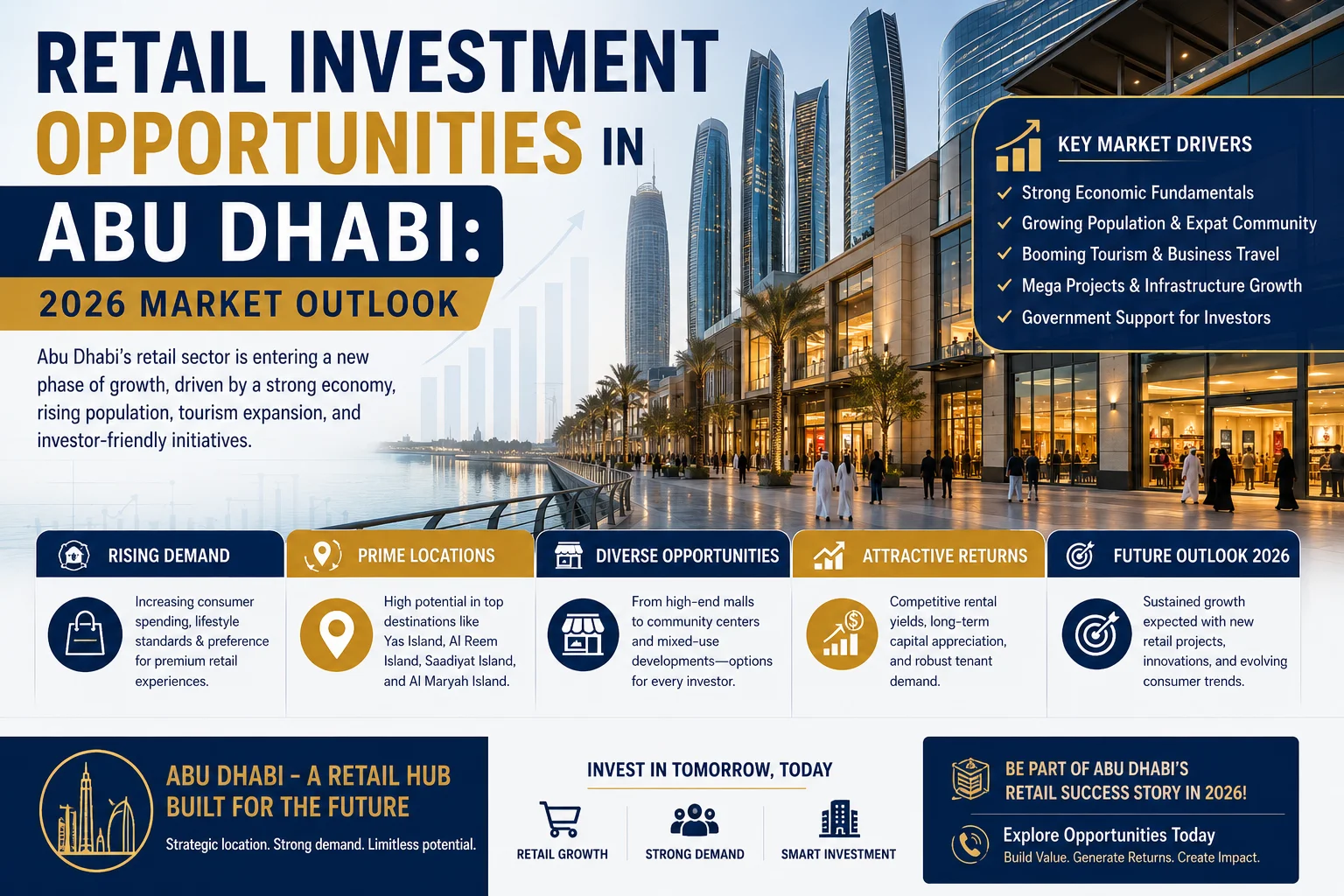
The story of Abu Dhabi real estate in 2026 has largely been told through residential and office numbers — record transaction values, surging foreign investment, and rents climbing across the board. But retail investment opportunities in Abu Dhabi deserve their own read, because the retail sector is behaving quite differently from the rest of the market this year: resilient in the metrics that matter most to landlords, yet clearly under pressure from structural shifts in how people shop. This outlook breaks down where retail stands heading into the second half of 2026 and what the trends suggest for the year ahead. This is general market information, not personalised investment advice — consult a licensed advisor before making investment decisions.
The Macro Backdrop
Abu Dhabi's broader property market has posted extraordinary numbers this year. Transaction values reached roughly AED 117 billion in the first half of 2026, up 112% year-on-year, with foreign direct investment into the property sector more than quadrupling compared to the same period in 2025. Office rents have climbed nearly 16% year-on-year with occupancy around 96%, and the residential market has continued to outperform, supported by sustained off-plan activity and strong domestic demand.
Against that backdrop, the UAE's overall 2026 GDP growth forecast has actually been revised slightly downward, reflecting disruption to trade, tourism, and aviation from regional instability earlier in the year — though a stronger recovery is expected in 2027 as conditions stabilize. That macro nuance matters directly for retail, a sector more sensitive to consumer spending and tourist footfall than office or residential assets.
Where Retail Stands Right Now
The clearest signal in the current data is a split between occupancy and sentiment. Retail markets have remained under real pressure from softer tourism flows and shifting consumer spending patterns — yet occupancy at major malls has stayed exceptionally strong, sitting around 95% in Abu Dhabi. Landlords, in other words, are not struggling to fill space. What they are managing is softer footfall and cost pressure on the tenant side, which so far hasn't translated into widespread rent concessions.
This is consistent with the broader UAE retail picture: despite headwinds, landlords have shown limited appetite to ease lease terms, and the market continues to behave, in the words of several retail consultants, as "a landlord's market."
The Two Forces Shaping Retail's Outlook
E-commerce growth. Online retail spending in the UAE is forecast to keep expanding significantly through 2028, and this shift is already contributing to softer rents and rising vacancies at some traditional, less differentiated mall formats. For anyone evaluating retail investment opportunities in Abu Dhabi, this is the single most important structural trend to price into any long-term view — not every retail format will perform the same way against this pressure.
Experience-led and leisure-integrated retail. The flip side is that retail bundled with entertainment, dining, culture, and lifestyle experiences has held up far better than standalone retail formats. Yas Island — which recorded tens of millions of visits in recent years — and Saadiyat Island's cultural district are the clearest examples of this shift, transitioning from pure tourist draws into permanent residential and lifestyle hubs with retail demand built into their growth.
Supply and Demand Fundamentals
Abu Dhabi's residential supply pipeline remains comparatively measured versus other segments — projected residential completions for 2026 are running below original forecasts, with delivery figures consistently lagging early projections in recent years. That controlled pace of residential delivery matters for retail too: it points to steady, rather than explosive, population growth in a given area, which tends to support more predictable, gradual retail demand rather than sharp swings.
Government-backed infrastructure investment is also a meaningful factor to watch. Planned rail and tram connectivity improvements — including links between key districts and the airport by the end of the decade — are expected to strengthen access to emerging retail and mixed-use nodes over the coming years, a trend that typically benefits retail assets positioned early in a growth corridor.
What This Means for Investors Through the Rest of 2026
Occupancy strength is a genuine positive signal. Near-full occupancy at major retail assets despite tourism softness suggests underlying demand for well-located retail space remains solid, even if individual tenants are under margin pressure.
Differentiation matters more than ever. The gap between traditional mall retail (facing e-commerce pressure) and experience-led, mixed-use retail (holding up well) is likely to widen rather than narrow through the rest of 2026. Location and format selection will matter more to returns than broad market timing.
2027 could bring a shift in tone. With a stronger economic recovery expected in 2027 as regional conditions stabilize, retail sentiment tied to tourism and consumer spending could improve meaningfully — worth factoring into any medium-term hold strategy rather than judging the sector purely on 2026's more cautious mood.
Tenant mix and lease structure deserve close scrutiny. Given cost pressures on retail tenants from supply chain disruption and softer discretionary spending, investors should look closely at tenant financial health and lease term structure rather than relying on headline occupancy figures alone.
Final Thoughts
Heading into the back half of 2026, retail investment opportunities in Abu Dhabi sit at an interesting inflection point: strong occupancy and a landlord-favourable rental environment on one hand, genuine structural pressure from e-commerce and softer tourism on the other. The clearest opportunities appear concentrated in experience-led, mixed-use retail formats in growth corridors like Yas Island and Saadiyat Island, supported by infrastructure investment and steady, controlled population growth. As always, the right approach depends on individual investment goals and risk tolerance — this outlook is meant to inform that conversation, not replace advice from a licensed real estate or financial professional.