
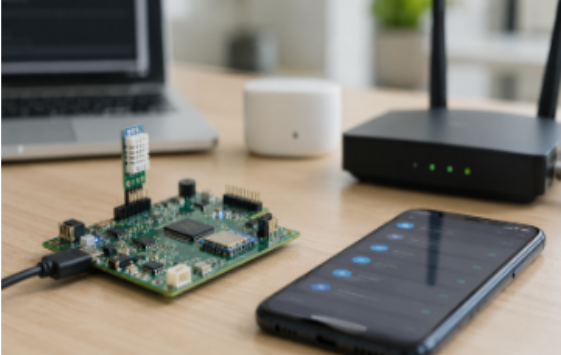
When people think about connected devices, Wi-Fi, Bluetooth, cellular, or other wireless technologies usually come to mind first. But building reliable connected hardware requires sensors, processors, power circuits, antennas, interfaces, and communication modules to work together. This is where integrated electronics production becomes important, coordinating different manufacturing requirements across the product, while professional PCB assembly for connected devices helps ensure that these interconnected electronic functions are assembled consistently.
Connectivity Adds More Hardware Than It Seems
Adding wireless communication to a product can affect much more than the communication module itself.
A connected device may require:
RF components and antennas
Sensors and signal-conditioning circuits
Microcontrollers or processors
Power management circuits
Memory and storage
External interfaces
Fitting these functions into compact hardware creates new manufacturing considerations, especially as board density increases.
The Antenna Area Deserves Special Attention
Wireless performance can be influenced by what happens around the antenna.
Component placement, nearby metal structures, connectors, shielding, and even the final enclosure can affect RF behavior. Assembly changes that appear insignificant elsewhere on the PCB may therefore matter more near RF-sensitive areas.
For this reason, PCB assembly for connected devices should follow the intended component placement and mechanical requirements carefully.
Power Behavior Changes Throughout the Day
Connected products do not always consume power at a constant rate.
A device may spend long periods sleeping, wake to collect sensor data, transmit information, and then return to a low-power state. These changing operating modes place different demands on batteries, regulators, and power-management components.
For battery-powered IoT products in particular, consistent assembly of the power section can be just as important as the wireless circuitry.
One Product May Combine Several Manufacturing Needs
Connected devices often mix technologies that require different production considerations.
The same product might contain fine-pitch ICs, RF modules, small passive components, through-hole connectors, batteries, displays, or mechanical assemblies.
This is where integrated electronics production becomes useful. Instead of treating PCB assembly, programming, testing, and final integration as unrelated activities, they can be coordinated around the requirements of the complete device.
A Connected Board Should Be Tested as a Connected Board
A board powering on successfully does not necessarily mean its connected functions are working correctly.
Depending on the product, functional verification may include:
Wireless communication
Sensor inputs
Power behavior
Firmware programming
Interface communication
Basic I/O functions
Testing the functions that matter in actual use provides more useful information than checking assembly appearance alone.
Conclusion
The defining feature of a connected device may be its ability to communicate, but reliable hardware depends on much more than the wireless module.
Effective integrated electronics production brings manufacturing, programming, testing, and integration together, while reliable PCB assembly for connected devices helps ensure the underlying hardware performs consistently as part of the complete connected product.